

Into Her Own Hands
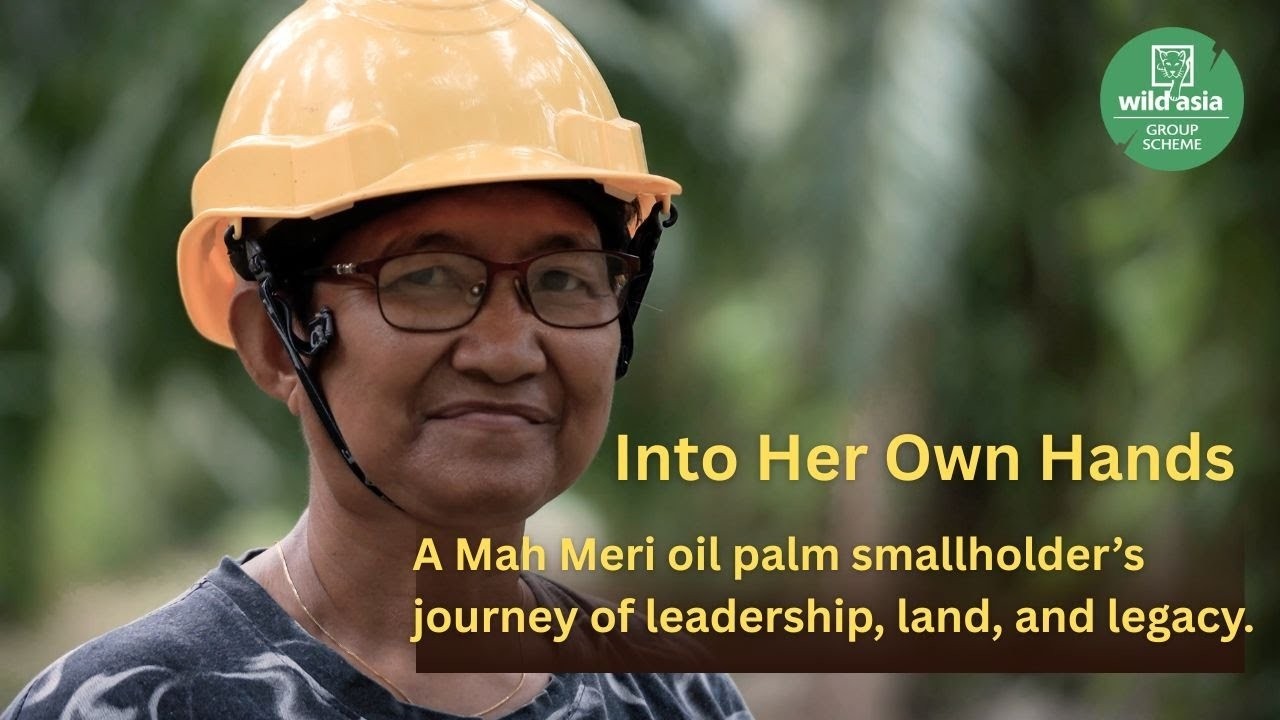
An oil palm smallholder, entrepreneur, and community leader, Reta Lajah is part of a new wave of Mah Meri women reshaping livelihoods, communities, and the landscapes they call home.
Reta Lajah still hears her late grandfather’s words ringing in her head: “You’re an Orang Asli (indigenous people), and you’re a woman. You must learn to make a living from the sea. Otherwise, you can’t feed your family, and life will be hard.”
Historical accounts describe the Mah Meri, one of 18 indigenous groups in Peninsular Malaysia, as descendants of nomadic seafarers. Reta’s grandfather belonged to the early generations whose ancestors settled on Carey Island in the 1800s.
For generations, they lived as small-scale fishers and mangrove hunter-gatherers along the Selangor coast, long before plantations and development transformed the landscape.
“My grandfather was a fisherman who also planted coffee and coconut. My father fished too and harvested Nibong palm (Oncosperma tigillarium) and mangrove to support us. But I decided to carve my own path,” says Reta, as we chatted in her backyard garden in Kampung Sungai Judah, Carey Island.
At 57, Reta has not just charted her own course; she has spent four decades bucking conventions,
breaking new ground for Mah Meri women, and challenging traditional notions of leadership.
Today, she is a sustainability-certified independent smallholder, a self-made entrepreneur, a community leader, a mother, and a grandmother.
Sowing the Seeds
Located 72km southwest of Kuala Lumpur, the bucolic village of Sungai Judah is one of five Mah Meri settlements on Carey Island. With a population of 515, its livelihoods rely mainly on oil palm and fishing.
Reta’s oil palm journey started early. Financial hardship forced her to drop out of school at 14. By the 1980s, oil palm already dominated Carey Island, and job options for a teenage girl were scarce.
“Other than fishing and foraging for crabs and clams, there weren’t many opportunities,” says Reta, the youngest of three siblings. “At 15, I started doing part-time estate work like collecting loose palm fruits.” In Malaysia, the legal minimum age for full-time employment is 15 years old.
To better support herself later in her youth, she took on full-time field maintenance work at Golden Hope Plantations Berhad (now part of SD Guthrie Berhad). Her tasks included weeding, applying herbicides, and monitoring for pests and crop damage.
“There were no machines then, so I used parang (machete) and cangkul (hoe) to clear weeds and picked rhinoceros beetles off the palm trees with my bare hands,” she laughs. Her monthly wage was MYR 120 (USD 29), back in the 80s. “But I learned a lot about oil palm farming at Golden Hope.”
Golden Hope was then gaining recognition for pioneering the Zero-Burning Replanting Technique, introduced in 1985, to replace the traditional slash-and-burn method of clearing land. Old, unproductive palms were felled and shredded, and left to decompose on-site to enrich the soil. This technique was later adopted as the industry standard for oil palm replanting.
“I believe if we're passionate about something, we just have to work for it.
Life has many challenges, but if we stay patient and
keep moving forward despite setbacks, success will come.”
Reta quit her job after marrying and giving birth to her first child in 1986. The following year, JAKOA
(Department of Indigenous Peoples Development) began allocating land plots for agricultural purposes.
Each adult in the community is entitled to about three acres, or more if they could clear and develop vacant land. Reta gained ownership of a nine-acre (3.6 ha) plot whilst her husband secured
five acres (2 ha).
“We couldn’t afford to hire heavy machinery, so we cleared the land using axes, handsaws and machetes. It was backbreaking,” Reta recalls. Mangrove timber from felled trees became cooking fuel, as gas stoves were uncommon then.
From fertilising to weeding and harvesting, Reta and her husband managed the farms themselves,
while raising four children.
“My husband prefers working quietly behind the scenes. I am the one who enjoys meeting people, asking questions, and making the decisions,” she says with a grin.
Taking the Lead
In 2012, Reta got to know about the Malaysian Palm Oil Board (MPOB)’s replanting programme from JAKOA. She rallied 39 smallholders from Sungai Judah to apply for the subsidy programme. They received free seedlings, chemical inputs, and a monthly MYR 500 (USD 121) stipend per farmer for two years.
“Caring for palm seedlings is like jaga anak (raising a child),” says Reta, who reaped her first harvest in less than three years. “You have to put in the time and effort. We even watered the seedlings during the dry season and maintained ground cover to keep moisture in the soil.”
She honed her farming skills further when she joined MPOB’s Sustainable Palm Oil Cluster (SPOC) programme to work toward MSPO (Malaysian Sustainable Palm Oil) certification in 2016. With guidance from TUNAS (Tunjuk Ajar Nasihat Sawit) officers, she adopted sustainable practices such as safe chemical use, soil erosion control, and better weed management.
“Our production costs went down, and our yields were good – over a tonne per acre – even though the palms were only five years old,” says Reta.
She achieved MSPO certification in 2017 and won MPOB’s Best Smallholder Awards (Anugerah Pekebun Kecil Sawit Terbaik) the following year, for exemplary farming practices and high yields.

In 2021, Wild Asia came to Carey Island to engage smallholders to join the Wild Asia Group Scheme (WAGS) to pursue RSPO certification.
“Before this, we just sold FFB (fresh fruit bunch) for income. Joining WAGS gave us direction and purpose to move forward, and access to global markets,” Reta admits. “Also, the opportunity to earn premiums for certified crops is a good incentive!”
She later attended WAGS BIO Awareness workshop and learned the basics of regenerative farming. Her son, Rajis, also an independent smallholder, manages a BIO plot using homemade natural enzymes and fertilisers. BIO practices are labour-intensive, and Reta cannot commit to it for now, she confessed.
Both Reta and her husband achieved RSPO certification in 2022. Today, their two sons help her husband manage the farms, with Reta chipping in whenever needed. Their combined monthly income from oil palm averages MYR 8,000 (USD 1,950).
Her Entrepreneurial Streak
With a keen nose for business, Reta is always seeking new opportunities. She didn’t just learn to fish; she became a seafood trader – buying and selling catches from local fishers. For six years now, she has headed the Sungai Judah Fisheries Network and Sungai Judah jetty, acting as a liaison with the Department of Fisheries. She oversees the welfare of the local fishers and the upkeep of the jetty.
However, the development of Westports neighbouring Carey Island and high cargo ship traffic have affected small-scale fisheries, Reta added.
“Fishing is integral to the Mah Meri identity,” says Reta, who also owns a fishing boat license. She earns about MYR 1,800 (USD 440) per month from seafood trading. “Even if it’s not a main livelihood for some of us, we fish for our family meals. Our rituals, stories, and craft heritage are all tied to the sea.”
Mah Meri women are known for their weaving tradition that spans generations. They weave mengkuang (pandanus) and nipah (Nypa fruticans) leaves into household and ceremonial items.
“Though I do weave ceremonial items like clothing and accessories, I’m not so interested in weaving. I prefer to sell the products!” she laughs. She buys woven pieces from local artisans and sells the wares at craft fairs and cultural events. With her daughters, she also designs and makes shell-craft ornaments using cockle, clam, and sea snail shells.
“I’m doing my part to promote our Mah Meri craft heritage.”

Reta also runs a thriving home catering business as a side hustle. She prepares breakfast and lunch for up to 250 guests at times. Her menu features local favourites such as nasi lemak (coconut rice), nasi ayam (chicken rice), and an array of kuih (local desserts).
“My Mah Meri-style sambal (chili paste) and steamed ketam bunga (flower crab) are especially popular,” she says. Palm oil (olein), she adds, is a staple in her kitchen.
“It’s versatile and affordable, and the perfect oil for deep-frying,” says Reta. “After all, I grow oil palm. I know exactly where it comes from and that it’s healthy and safe.”
From 2022 to 2024, she chaired the village development committee (JPKKOA Sungai Judah). In 2024,
she rallied the youths in her village to join a competition for the “Most Beautiful Orang Asli Village in Malaysia.”
“We created decorations from recycled waste to beautify our village,” Reta says proudly. “We
clinched second place and a MYR 20,000 (USD 4,900) cash prize.”
As if she’s not busy enough, this grandmother of eight cares for three grandchildren full-time and serves as the PIBG (parent-teacher association) head at the Sungai Judah primary school.
What Drives Her
Across farming, business, or community leadership, Reta is anchored by these convictions.
“I believe if we are passionate about something, we just have to work for it,” says Reta.
“Life has its challenges – air pun ada pasang surut (ebbs and flows) – but if we stay patient and
keep moving forward despite setbacks, success will come.”
For her, it all comes down to three qualities: humility, patience, and discipline.
By taking charge of her own trajectory, she shows how an indigenous smallholder can redefine livelihoods, leadership, and the future of her community.

This story is part of the Malaysian Sustainable Farmer Chronicles farmer profile series, a collaboration between Wild Asia and the Malaysian Palm Oil Council that shares the innovations and best practices of MSPO-certified smallholder farmers in Malaysia.